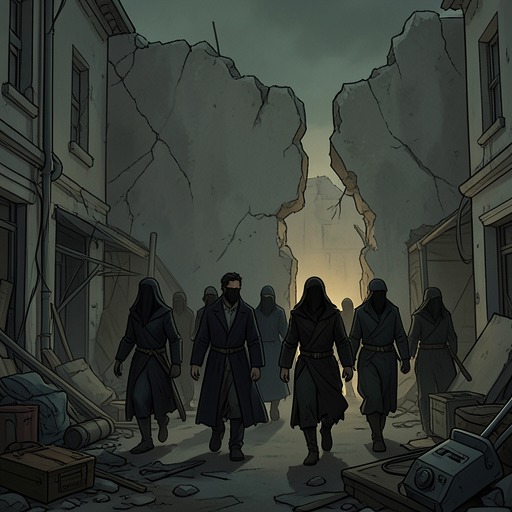
First Colony Martial-Law Order
The Passage (Justin Cronin Edition)The First Colony Martial-Law Order is an emergency declaration made by Ian during the Colony’s political breakdown. As the crowd threatens Alicia and the Watch intervenes, Ian suspends the Household, imposes an immediate curfew, and places the Colony under the Watch’s enforcement. Its reach is explicit: the gates are to remain closed, people found outside may be arrested, and anyone carrying a weapon may be shot.
Background and Emergency
The declaration follows a crisis that has already disrupted the Colony’s ordinary authority. Earlier, after deaths, fear, and uncertainty spread through the settlement, the Household declared a civil emergency: activity beyond the Wall was suspended, the herd and work crews were kept inside, the gate remained closed, and Caleb was held in the lockup. The Household deferred judgment on him while the Colony tried to understand what had happened.
That earlier response distinguishes a temporary suspension of outside activity from Ian’s later, more forceful order. When the crowd gathers around Alicia, the Watch forms a line between the people and the table. Ian then announces that the Household is suspended and that martial law is in effect, shifting emergency authority into an immediate command over public movement and armed force.
Provisions and Enforcement
Ian orders people to return to their homes and declares an immediate curfew. The gates are to stay closed until further notice; anyone seen outside is subject to arrest by the Watch, and anyone carrying a weapon may be fired upon. These provisions make the order more than a general appeal for calm: they specify who will enforce it and what penalties may follow disobedience.
The declaration comes amid an already fragile system of collective rule. The Colony’s founding law describes the Household as responsible for domestic order, equal shares, sanctuary protection, fair work and trade, and common defense. Ian’s suspension of that body therefore places ordinary governance on hold in the name of containing the immediate crisis.
Alicia’s Arrest and the Order’s Consequences
The order does not resolve the conflict surrounding Alicia. Ian publicly names her and charges her with treason, while a voice in the crowd demands that she be put out. As Peter kneels beside her, Alicia mouths a single instruction to him: “Go.” The Watch then leads her away, leaving Peter unable to intervene.
The episode shows the order’s practical force and its limits. It restores immediate control of the street by dispersing the crowd and restricting movement, but it does so while Alicia is taken into custody and public authority is visibly divided between the suspended Household, Ian’s emergency command, and the Watch. The martial-law declaration is thus both a security measure and a turning point in the Colony’s breakdown: order is asserted through restrictions and force, without settling the dispute that prompted the crisis.